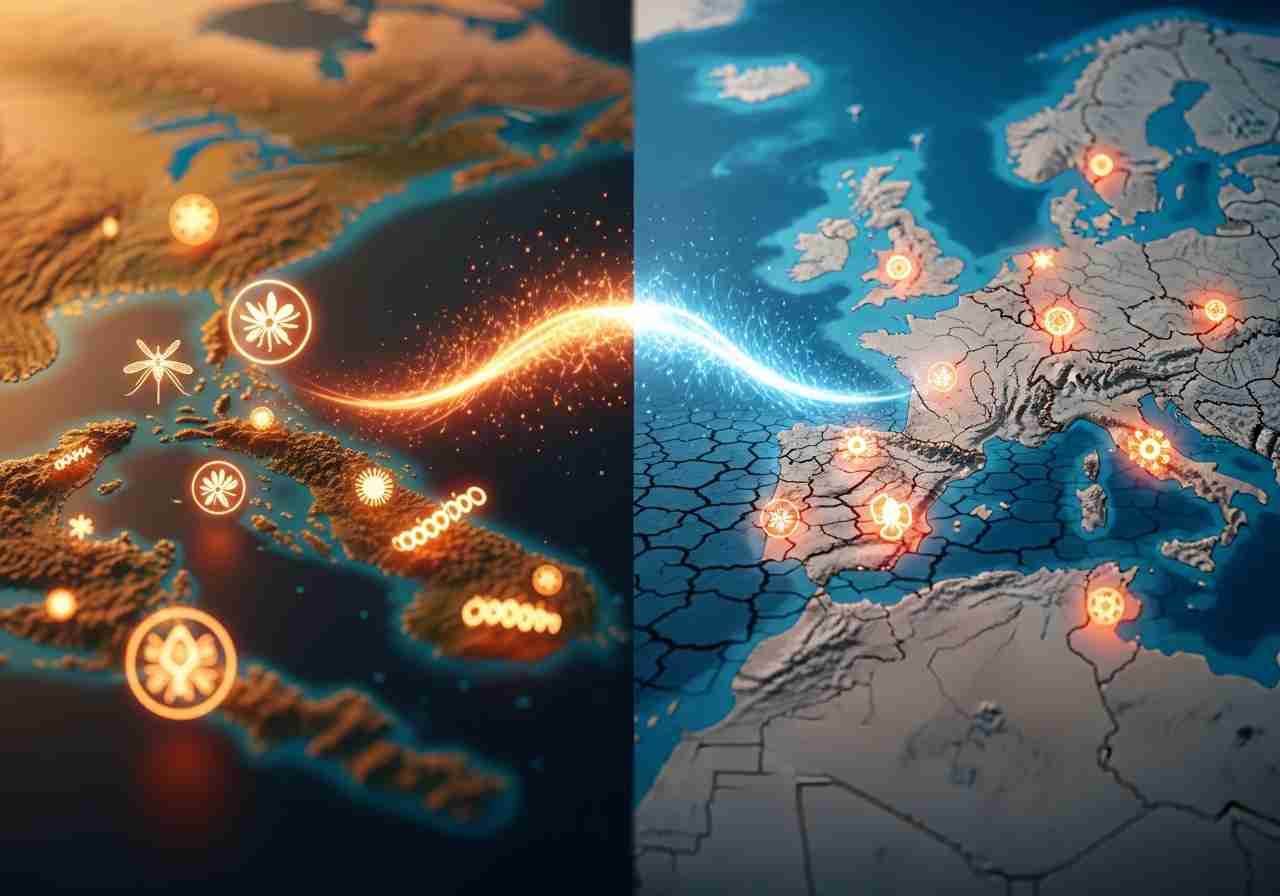
Have you ever thought that mosquito that is buzzing in your ear does not sound the same as it used to? It is perhaps not your fancy. We are living in a changing climate and this change is slowly but surely altering the realm of infectious disease right under our noses. Most of the time we envision the health consequences of warming up the planet as heatstroke or injuries of a disaster. But there is an even more sinister intrusion in the new streets. Plagues that were once restricted to remote and tropical areas are now finding warm welcomes where previously there were reasons and causes that were too cold or too dry. This is not a projection in the future. It is the prevailing situation of our international health care environment.
The Unseen Machine of Outbreaks
What is the direct effect of a warmer world on us making us sicker? It is a force multiplier, an increase in the dissemination of pathogens. Think about the mosquito. Higher temperatures are seen to speed up its life cycle. This implies that the number of generations of the mosquitoes is multiplied per season. The virus within them such as the dengue also replicates at a quicker rate. As a result, a shortened interval between the mosquito picking a virus and transmitting it becomes possible. This sets up an ideal scenario of quick outbreak possibilities in the new population which is unprepared. The health risk calculus is undergoing an update.
- According to disease ecologist Dr. Anya Sharma, the geographical prison of those illnesses is being opened.
- She continues by stating that the maps that we consult in medical textbooks are being outdated within a few years, not decades.
Knocks of Dengue Fever on New Doors
Let us consider a real-life example. The southern Europe is at the center stage. In 2023, France registered more than 65 local-acquired dengue cases, which caused an alarm among the health professionals of the land. This was not from travelers. These were individuals who had been bitten by the local mosquitoes which were infected with the virus. The Aedes albopictus aka tiger mosquito has successfully colonized the continent with breeding colonies. Its eggs are able to survive in warmer winters. Warmer summers are then allowing explosive population growth. All at once a tropical invader is approaching a health care system set up to meet temperate infections.
A Parasite’s New Playground
Another chilling example can be the water-borne parasite Schistosoma. It had decades without being present in European waters. Then, locally, in the Corsica in 2014, urogenital schistosomiasis was transmitted. This marked a dramatic shift. How did this happen? The life cycle of the parasite is dependent on a freshwater snail. Lakes that were once rendered uninhabitable due to warm waters have transformed into snail habitable areas. The direct relationship between change in temperature and the establishment of the parasites demonstrates the complex character of the threat. There is no separation between our environmental and health fate.
Doctors Guessing When Holding Nothing
Suppose you are a family doctor in Texas. One of the patients presents with a non-healing skin sore that is strange. Cutaneous leishmaniasis is another type of parasitism disease that was not part of your training, and at one time was uncommon in the U.S. It is the crisis of the diagnostic delay. Physicians in temperate countries are not prepared to identify these new dangers. I once talked to a health care worker in northern Texas who spent months trying to find out the cause of the constant skin ulcer of a rancher. It happened to be locally acquired leishmaniasis. The patient had never been to other countries. This experience as a individual points out to a very important deficiency in our health care preparedness. Our studies in medicine are failing to keep up with an evolving planet.
The Velvet Underground: A Perfect Storm of Vulnerability
Newly opened numbers are put in a double predicament. They are immunologically naive, which is to say that their bodies have never come across such pathogens. This may result in more serious disease. In addition, the local health care infrastructure is not ready at all. No surveillance programs, no awareness campaigns to the population, no stocks of the drugs needed. The system is taken off its guard. This poses a great weakness to our community health defense. The response is being constructed as we develop the crisis.
The Health Care Systems Ripple Effect
The stress does not end at the diagnosis. Treatment of such ailments may be complicated and expensive. A single case of leishmaniasis that is resistant to drugs, treated, will demand special medicines and long-term hospital treatment. This is a diversion of valuable resources to other important health care services. It is a waste of resources and manpower. A new disease burden may impose a financial strain that is enormous. Now we need to make investment in preparedness so that we do not have to pay much later. Our healthcare systems should be made more responsive and visionary.
An appeal to a climate-smart health
So, what is the solution? We have to combat the carrier and not only the virus. It involves incorporation of climate data into our health policies. We require anti-prophylactic surveillance. This model involves prediction of possible hotspots of outbreaks using weather forecasts and climate estimates several weeks beforehand. Then we can attack the mosquito control efforts in advance. This is a smarter way and the future of successful health care in a warming world. It is concerning being ahead of the problem rather than incessantly responding.
The Delusion of Dissociation is Gone
The growth of the neglected tropical diseases is a loud alarm. It breaks the myth that some of the health problems belong to them and not to us. Our well-being directly and literally relies on the environmental decisions we make regarding emissions, to land use. The future of a community that is at risk of dengue in Brazil is now connected with a community in France. The future of our health care and that of all the people lies in recognizing this interrelationship. We should no longer consider planetary and human health as independent of each other. They are one and the same. The question remains to be will we react in the urgency this crisis requires?