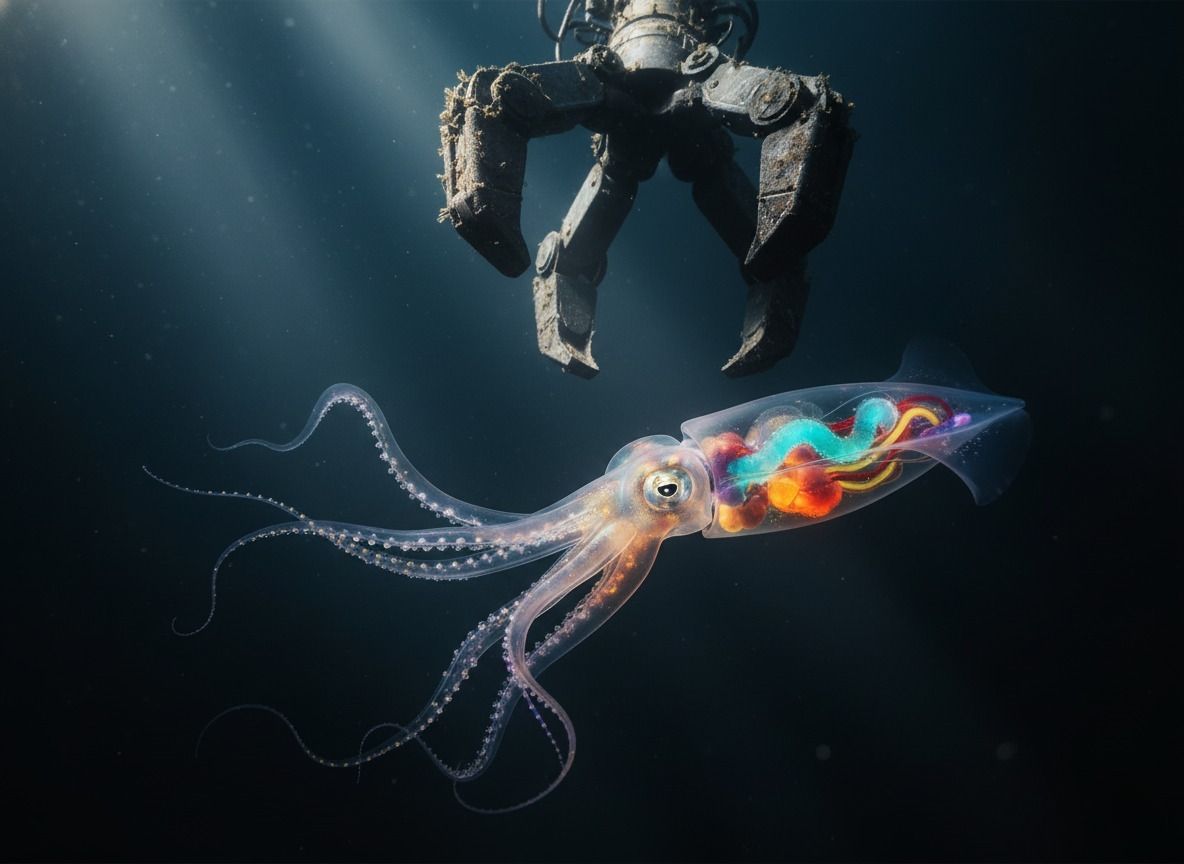
Wonder what the real aliens would look like? Forget distant galaxies. There they are being discovered here on our planet, in the pounding darkness of our deep oceans. The latest expeditions to uncharted depths have shown a menagery of life so unbelievable as to be out of this world. This is a phenomenal finding that is redefining the textbooks of biology. Are we ready to save these weak planets?
Final Frontier Lies in Silt
We can tell more about the surface of the Moon than we know about our ocean floor. That’s changing fast. Currently, new submersibles such as the DSV Limiting Factor are able to go to the bottom of the Mariana Trench. This is high-tech craft which is our underwater eyes. They unveil a world of unending darkness, huge stress and unexpected biodiversity. It is not merely exploration, but it is a basic find of our planet.
- According to the saying of a marine ecologist called Dr. Regan Dunn, the world is in a new Golden Age of deep-sea discovery. Every one of our dives gives up something that we have never imagined.
- The data is staggering. Over a 10-year period, Ocean Census is expected to discover 100,000 new marine species. They are already ahead of time. It is not such a mission as counting species. It is all about the awareness of the extreme boundaries of life itself.
A Gallery of Deep-Sea Bizarre
Speaking some of these wonderful animals. On the abyssal plains, researchers were able to discover a glass squid that had totally transparent skin and optic nerves. You can look through its head all the way through. What happens to the evolution of such a creature? It makes a very good disguise in the all-darkness.
- In the meantime, another snail was discovered near one of the volcanic vents. It is armored with iron sulfides in its shell. We refer to it as the gastropod of the scaly foot. It literally takes metal as a part of its body. Such one discovery may transform the science of materials. Its structure is already under study by engineers.
- Dr. Ken Halanych, who is an invertebrate zoologist explains that they do not meet in order to be weird. Each unusual appearance is a brilliant idea on how to live in the harshest conditions on earth.
- Then there is the haunted octopus, “Casper.” It is found off Hawaii and incubates its eggs in a period of more than four years on manganese nodules. This renders it immensely vulnerable. Why? Due to the fact that deep-sea mining companies target the same nodules.
The Two-sided Sword of Discovery
This is where the main conflict lies. These fantastic lifeforms are being discovered when industry is targeting their habitat. Clarion-Clipperton Zone is a huge abyssal plain. It is full of polymetallic nodules of cobalt and nickel. These are essential to the batteries of electric cars. The mining equipment is on hand. But so are the scientists and their appalling discovery.
The exploitation of these regions would entail large robots cleaning the bottom of the sea. The process would develop massive plumes of sediments. Such plumes would suffocate whole ecosystems in hundreds of miles. The animals growing slowly such as glass sponges which are thousands of years old would not revive.
One of the sentencing examples is the Yeti Crab
Consider the Yeti Crab that was found in 2005. It feeds itself on bacteria near warm vents upon its hairy claws. This was a beautiful finding of a symbiotic relationship. Suppose, however, that some mining work had destroyed its vent while we were still searching. Not only the crab, but the particular knowledge which it possesses, would have been lost. New enzymes are generated by its bacteria. They may contain the secret of new drugs or manufacturing. With which other biological solutions shall we wipe out before we even discover them?
An Expert’s Personal Insight
I interviewed a geobiologist by the name Dr. Sylvia Smit who was able to spend well over 1,000 hours working in the submersibles. Her perspective is chilling. It takes two hours to get down to utter blackness, she said. Then, you are going to see some light. An entire eco system survives in this toxic, frozen surroundings. It feels like another planet. But it’s ours. To ruin it in order to score short-term advantage is a terrible inability to imagine. We are setting the library of life ablaze, which we are not yet even going through.
- Her words stick with you. It is not all about conservation. It’s about wisdom. Deep sea represents a living library. A species of knowledge is each a book. We are just beginning to know how to read them.
A Choice in the Abyss
Who are we supposed to be responsible to? We stand at a crossroads. One of the ways will result in unregulated resource extraction. The other requires the protection of the world and critical exploration. The recently ratified treaty of the High Seas provides a pattern on the establishment of marine secure areas. We must use it.
The last lesson is as follows: It is not a new species that has the largest discovery. The knowledge that the prosperity of our future is in the well being of these unfathomable depths. It is up to us either to be custodians of this last great wilderness, or to be its exterminators. The vote is happening now. We must ensure that we are on the right side of history.